Zepbound for Sleep Apnea: The SURMOUNT-OSA Trials
A weight-loss drug earned a breathing indication, and the trials behind it are more elaborate than the idea they tested.
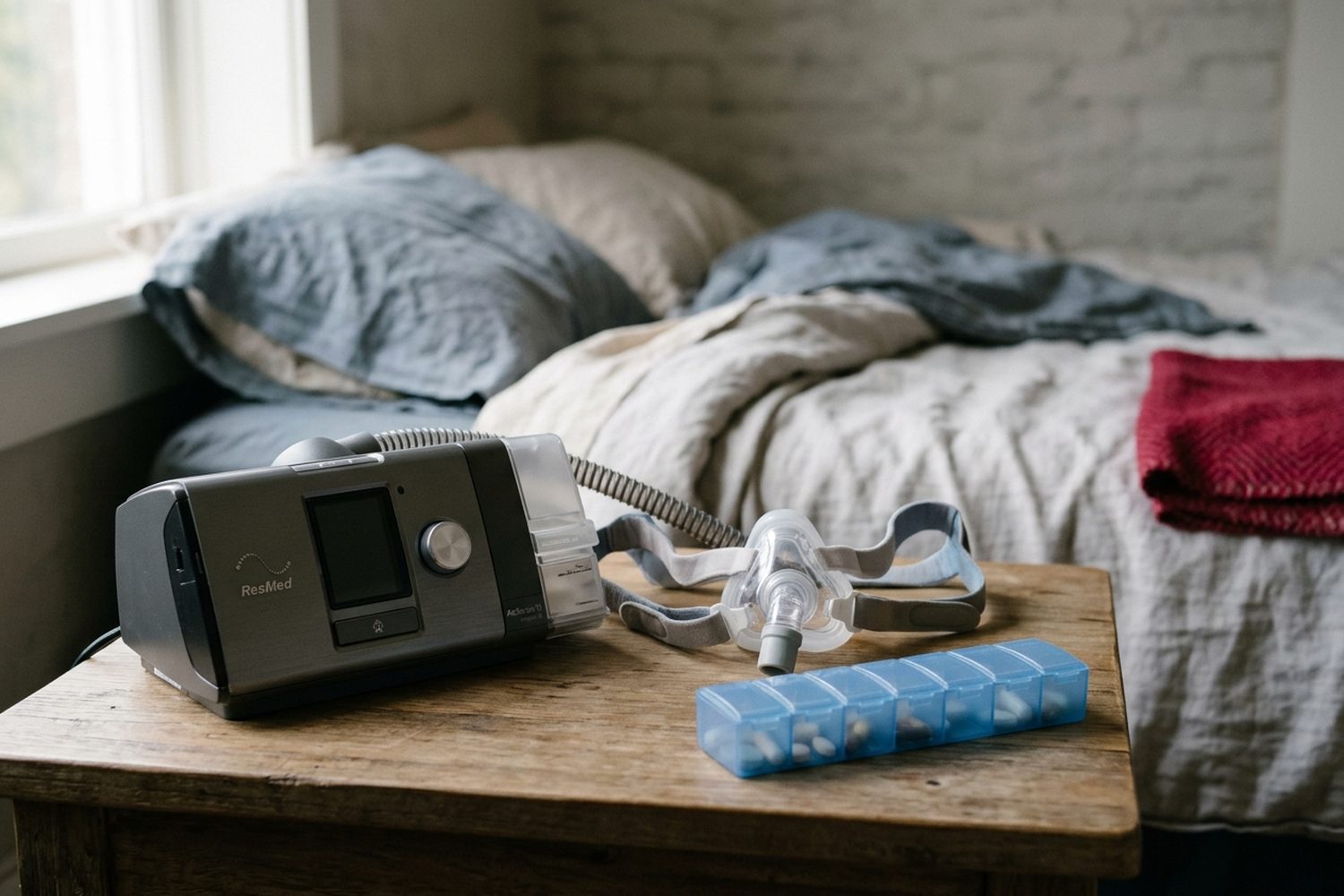
In December 2024 the FDA approved a weight-loss drug for a breathing problem. A review in the medical literature, “Glucagon-Like Peptide-1 Receptor Agonists for Obstructive Sleep Apnea,” describes tirzepatide (sold as Zepbound) as “the first medication specifically indicated for moderate-to-severe obstructive sleep apnea in adults with obesity.” So if you searched for zepbound for sleep apnea, the plain answer is that this is an approved use, for adults with obesity and moderate-to-severe disease. It was also the first drug approved for that condition at all.
The approval rests on SURMOUNT-OSA, a program of two Phase 3 randomized, double-blind trials with 469 participants in total. The number they measured is the Apnea-Hypopnea Index, or AHI, which counts how many times per hour a sleeping person stops breathing or nearly stops. Compared with placebo, tirzepatide cut the AHI by roughly 20 to 24 more events per hour. That held both in people who were not using a CPAP machine and in people who were.
What is the simple version of the weight-loss argument?
Here is the dumb version of this story. Doctors have told people with sleep apnea and obesity to lose weight for a long time. The SURMOUNT-OSA design paper puts it this way: “Weight reduction is a standard clinical recommendation for OSA treatment in people with obesity or overweight, but weight loss is characterized as challenging to achieve and maintain without bariatric surgery.” The theory, in its dumb form, is that weight is part of what closes the airway at night. Less weight, less closing.
The entire argument fits on a refrigerator magnet, with room left over for a takeout menu.
The trouble was never the theory. The trouble was the second half of that sentence, the “challenging to achieve and maintain” part. Before SURMOUNT-OSA, according to the same design paper, no approved anti-obesity medication had shown it worked for managing sleep apnea. An earlier trial of liraglutide called SCALE Sleep Apnea had, in the words of one narrative review, “established proof of concept that pharmacologic weight loss can improve the primary AHI outcome in OSA.” Proof of concept is a nice thing to have. It is not an approval (the FDA does not, as a rule, approve concepts).
How the SURMOUNT-OSA trials were built
Now the sophisticated version. SURMOUNT-OSA was a master protocol with two arms that the designers called intervention-specific appendices (a phrase that has never once been said aloud at a dinner party). The first enrolled 234 people who were not using any sleep apnea treatment. The second enrolled 235 people who were already using positive airway pressure, which mostly means a CPAP machine.
To get in, you needed a BMI of at least 30 and an AHI of at least 15 events per hour, which is the line for moderate-to-severe disease. Participants got tirzepatide at the maximum dose they could tolerate, 10 mg or 15 mg, or a placebo, for 52 weeks. Then came overnight sleep studies, plus digital wearables, home sleep testing and accelerometers to track daily movement as exploratory outcomes. The National Institutes of Health is listed with six separate grants. The key secondary endpoints included hypoxic burden (roughly, how starved of oxygen people get during the night), patient-reported sleep impairment and disturbance, a blood marker of inflammation called hsCRP, and systolic blood pressure. All of them improved compared with placebo.
This is a lot of machinery to test a refrigerator magnet. I suppose that is what it costs.
Here is a made-up scenario to show how far the logic can go. A drugmaker notices that people on its drug are lighter, and that lighter people take up less of an airplane seat. So it runs a 469-person double-blind trial on armrest disputes, with polysomnography swapped out for an elbow-contact sensor. The primary endpoint is armrest incursions per flight hour, and the secondary endpoints are hypoxic burden in the middle seat and patient-reported resentment. It passes, and the FDA approves the first medication specifically indicated for moderate-to-severe armrest conflict. This has not happened. In some sense, though, it is the same shape as what did.
What the AHI numbers actually showed
In the first trial, the people not on CPAP started with a mean AHI of 51.5 events per hour.
Sit with 51.5 for a second. It means that, on average, these people’s breathing stopped or nearly stopped a little less than once a minute, all night. Over an eight-hour night that comes to about 412 times. The half-event is my favorite part. Nobody stops breathing half a time, of course, but averages do weird things, and somewhere in that average is a person whose body is keeping very busy while they appear to be asleep.
Tirzepatide reduced the AHI by 25.3 events per hour, against 5.3 for placebo (the placebo group, to be fair, also tried), a difference of 20.0 (P<0.001). Put more modestly, the drug took away about half of the problem. Across the two trials, 42% to 50% of people on tirzepatide reached what the trials called disease remission. That meant an AHI below 5, or below 15 with no symptoms. Between 68% and 79% of people on tirzepatide moved down a severity category. On the other hand, 64% to 70% of people on placebo saw no clinically relevant change in their category at all.
Post hoc analyses sliced the results by age, sex, BMI, neck size and starting severity. The reductions ranged from 12.1 to 52.2 events per hour across severity subgroups, and the people with more apnea to lose generally lost more of it. In the first trial, sleepiness scores on the Epworth scale also improved compared with placebo. (I have now read more sleepiness questionnaires than is good for a person, which says something about my job and possibly about my evenings.)
Zepbound for sleep apnea with and without CPAP
The second trial is the one that gets weird. It enrolled people who already used positive airway pressure. These are people who sleep every night attached to a mask that makes them sound a bit like Darth Vader. The relationship between a person and their CPAP machine is close, it happens every night, it involves a lot of heavy breathing, and where the person ends and the device begins is a little blurry.
To measure whether the drug did anything, the trial took the machine away. Before the sleep studies and the questionnaires, positive airway pressure was withdrawn. Picture the technician: “Okay, mask off tonight, we need to see what you’ve really got.”
This makes sense once you think about it. A working CPAP machine pushes the AHI down by itself. If you measured with the mask on, you would mostly be grading the machine. With the mask off, the trial could see whether the underlying apnea had changed. It had. The difference against placebo was 23.8 events per hour (P<0.001), a bit larger than in the first trial.
What the trial did not directly answer is how a person does on drug plus mask together, every night, for years. It measured the disease with the mask removed. That is a fair question for the trial to ask. It is just not the same question.
What the first sleep apnea approval does and does not settle
The approval settles that a drug can carry a sleep apnea indication of its own. It does not settle who should get it. The GLP-1 review says these drugs are appropriate for patients with BMI above 30 who cannot tolerate CPAP or who have obesity-related conditions, but are “unlikely to benefit individuals without obesity or those with primarily anatomical obstruction.” That is the dumb version again, really. If weight is not what is closing your airway, removing weight does not open it. How the label changed who pays for the drug is its own story, and the site covers it separately.
And the long road keeps going. Lilly’s oral drug orforglipron is in ATTAIN-OSA, another master protocol with two double-blind trials. This time people who are overweight but not obese can enroll too, partly because injections were cited as a barrier to sticking with treatment. Its primary endpoint is change in AHI at week 52. Its key secondary endpoints are hypoxic burden, sleep-related impairment, hsCRP and body weight. It is the same refrigerator magnet with a new pill attached, lol.
In SURMOUNT-OSA, every participant, placebo group included, also got a lifestyle intervention for weight reduction.
Sources
- Association of tirzepatide with changes in OSA-related measures based on baseline characteristics - post hoc analyses of SURMOUNT-OSA
- Incretin-Based Therapies in Obesity-Related Obstructive Sleep Apnea: A Narrative Review of Evidence Tiers and Mechanistic Plausibility
- Tirzepatide for the Treatment of Obstructive Sleep Apnea and Obesity
- Tirzepatide Improves Outcomes in Patients With Sleep Apnea ...
- Glucagon-Like Peptide-1 Receptor Agonists for Obstructive Sleep Apnea: A Review
- Orforglipron for the treatment of moderate-to-severe obstructive sleep apnea in adults with obesity or overweight: Study design and baseline characteristics of ATTAIN-OSA, a phase 3 trial
- Tirzepatide for the treatment of obstructive sleep apnea: Rationale, design, and sample baseline characteristics of the SURMOUNT -OSA phase 3 trial
- Effect of tirzepatide treatment on patient-reported outcomes among SURMOUNT-OSA participants with obstructive sleep apnea and obesity
Incretin Med explains published research for clinicians and curious readers. It is not medical advice, and it never recommends a dose, a product or a seller. Talk to a clinician before you start, stop or change any medicine.