Semaglutide and Knee Osteoarthritis: The STEP 9 Trial
Semaglutide may help knees, but nobody can say how much of it is the drug and how much is the scale.
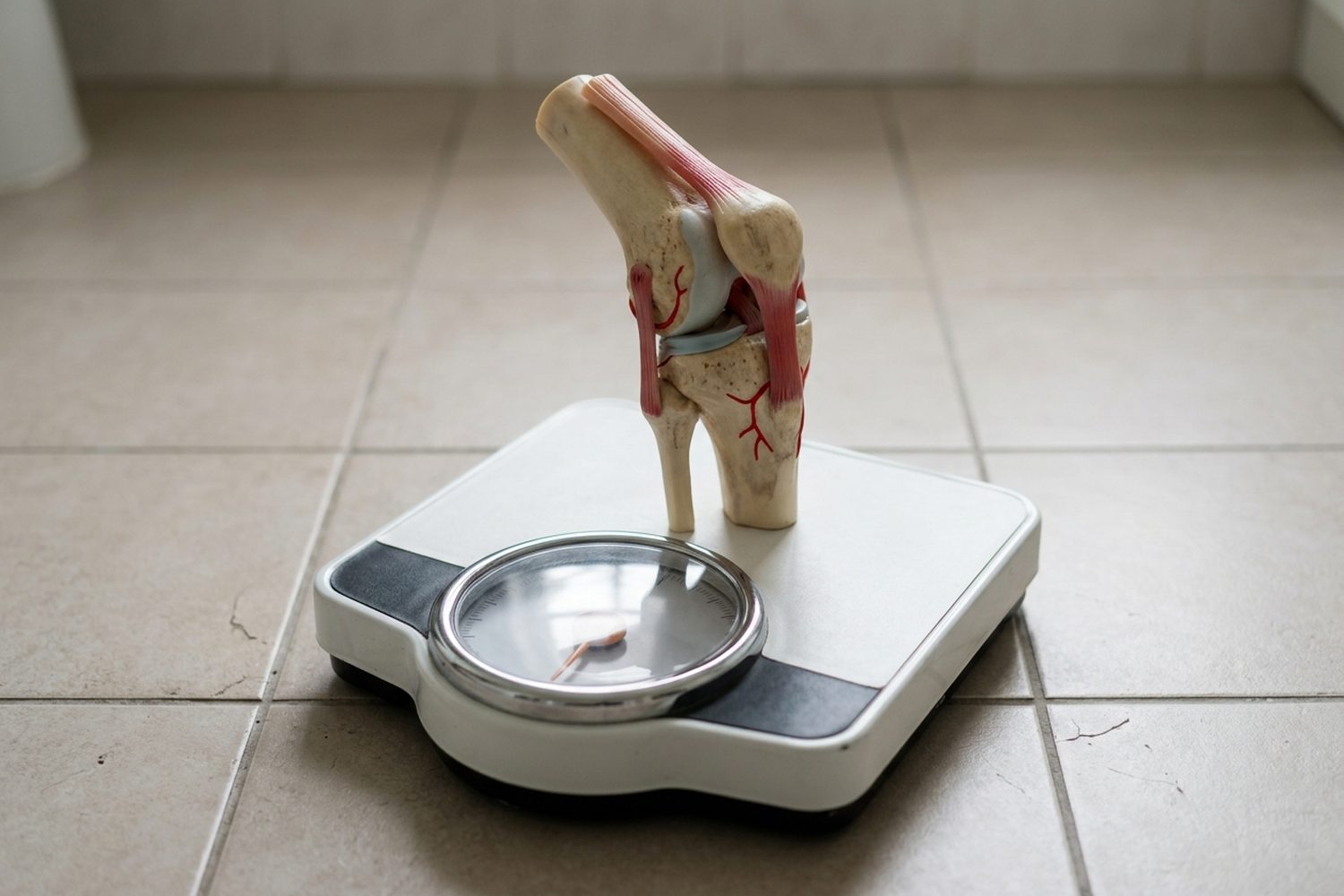
STEP 9 is a trial that gave semaglutide, a drug best known for making people lighter, to people whose knees hurt. That sounds like a trial about knees. It is also, unavoidably, a trial about everything above the knees, because osteoarthritis of the knee is a disease of a joint that spends all day holding up the rest of the person.
Here is the honest answer to the glp-1 osteoarthritis question, as far as the sources behind this article go. They do not report STEP 9’s pain and function numbers, so I am not going to invent any (it would be easy, and it would be wrong). What they do settle is the shape of the argument. The FDA has granted Fast Track designation to an intra-articular GLP-1 receptor agonist formulation for knee osteoarthritis. The reason anyone would build such a thing is that nobody can yet say how much of a GLP-1’s effect on a knee comes from the drug and how much comes from the scale.
GLP-1 drugs and osteoarthritis: drug effect or weight effect
Let us set out the knee hypothesis with the seriousness it deserves. Proposition one: the knee is located beneath the body. Proposition two: the body has weight. Proposition three: semaglutide reduces that weight. In the SELECT heart trial, people on it lost about 9.4% of their body weight at 104 weeks, against about 0.9% on placebo. It follows, by reasoning that would survive peer review, that the knee will be carrying less.
That tidy syllogism is also the reason a knee trial of this drug is so hard to read. Any knee trial of a systemic weight-loss drug has weight loss baked into the treatment arm. If pain goes down and walking gets easier, the drug gets credit. But the same credit would go to anything that took off the same pounds.
So the direct-effect question is whether semaglutide does anything for the knee. No, that is wrong, or at least too easy. Everyone agrees it does something for the knee, by shrinking the person attached to it. The real question is whether it does anything for a knee that it would not do for a knee whose owner lost the same weight by some other route (a diet, surgery, a long unhappy year). That second question is much stranger, and it is the one with money attached.
Who gets paid for which answer
Follow the chain. A drug company sells against what is on the label, and the label comes from trials. A knee trial of a strong weight-loss drug is, I assume, a decent bet to show something, because weight loss is a strong knee treatment. (This is the comfortable part of the chain.)
But a win that is “really just weight loss” is a weaker story than a win that is “something the drug does to joints.” The first invites a shrug from everyone deciding whether the drug is worth paying for in knee patients specifically. The second is a new indication with its own logic. I feel like this is where the incentive starts bending the science, gently, toward the question of mechanism.
Here is some invented dialogue, of the kind a trial statistician produces for a living: “Great, the pain scores moved. Now tell me how much of that is the scale.” And the honest reply is usually some version of “I don’t know, and the design won’t let me know.”
It is the old sports puzzle of the point guard who comes back faster after the offseason. He got new shoes. He also dropped fifteen pounds. The shoe company has opinions. So does the nutritionist.
How the heart trials tried to split the difference
The cardiology people have fought this exact fight. In SELECT (which has its own page on this site), the heart benefit “appeared early and was not fully explained by the degree of weight loss achieved,” per research notes on the trial. A pooled analysis of SUSTAIN-6 and PIONEER-6 found the effect on major cardiac events stayed similar after accounting for body weight changes. And a 2026 post hoc analysis of SUSTAIN-6 concluded that “weight-independent mechanisms may mediate the cardioprotective effects of semaglutide.”
Note the verb. May. (Post hoc analyses are not in the business of saying “do.”) These are statistical adjustments on trials that were not built to separate weight from drug, which is about the best anyone can do once a trial is over. To be fair, they are also roughly what a knee trialist would do: slice the treatment group by weight lost and see whether pain improvement tracks the pounds.
That approach has a known hole. People who lose more weight on a drug may also be the people who respond more to the drug in other ways, so the slicing cannot fully pull the two apart. Hearts and knees share the hole.
What the liver trial said about pain
One stray data point is worth a look, because it is about pain and comes from a semaglutide trial that was not about pain at all. In ESSENCE, the liver trial (again, it has its own page), mean body weight fell 10.5% with semaglutide versus 2.0% with placebo. That is a lot. And yet the published ESSENCE report says “mean changes in bodily pain scores did not differ significantly between the semaglutide and placebo groups.”
Look, this is easy to over-read. A general bodily pain score in liver patients is not a knee pain score in knee patients, and ESSENCE did not enroll people because their knees hurt. But it is a small reminder that “lost 8.5 percentage points more weight” and “hurts less” are not automatically the same sentence. Whether they are the same sentence in a knee trial is exactly what is not settled here.
Why the cleanest test removes the weight loss
This next part is a made-up scenario. Imagine a systemic semaglutide knee trial in which each participant wears a weighted vest, and every week a technician adds exactly the pounds they lost, so their knees carry a constant load. The placebo group wears vests too, for blinding. Then the technicians notice the placebo vests never get heavier, so they add decoy weights and quietly remove them again. Participants start comparing vest heft in the waiting room. The vest technicians unionize. Eventually a great deal of money has been spent keeping everyone’s knees exactly as burdened as before, to test a drug whose main feature is unburdening them.
The real-world version is tidier, and it is the one that just got a Fast Track. An “intra-articular formulation” is the regulatory phrase for a drug that skips the introductions and goes straight into the joint. The idea, presumably, is that a drug kept in the knee does little to the waistline, so whatever benefit remains is the direct effect, if there is one. A report on the FDA decision described it as “signaling regulatory recognition of potential structural and analgesic benefits beyond systemic weight-loss effects.”
Note “potential.” (A designation is not a result, and the facts here say nothing about results.)
Where the chain ends up
Between us, the arc is a little funny. GLP-1 drugs became enormous because they cause weight loss. Their makers went looking for new indications, and found that in knees the weight loss works almost too well, crowding out any claim that the drug does something special. So to prove that a weight-loss drug helps knees for reasons beyond weight loss, the field is building a version of it that is designed not to cause weight loss.
I mean, that might work. A direct effect on the joint itself would be a new thing, and the systemic trials cannot rule it in or out. STEP 9 asks what happens to knees when people take the weight-loss drug. The injection asks what happens to knees when they don’t lose the weight.
The best case for the drug is the version that skips its main trick.
Sources
- FDA Fast Tracks Intra-Articular GLP-1RA for Knee ...
- Effect of semaglutide versus placebo on cardiorenal outcomes by prior cardiovascular disease and baseline body mass index: Pooled post hoc analysis of SUSTAIN 6 and PIONEER 6
- Phase 3 Trial of Semaglutide in Metabolic Dysfunction-Associated Steatohepatitis
- Semaglutide and Cardiovascular Outcomes in People with Type 2 Diabetes: A SUSTAIN-6 Post Hoc Analysis by Weight Loss Category
Incretin Med explains published research for clinicians and curious readers. It is not medical advice, and it never recommends a dose, a product or a seller. Talk to a clinician before you start, stop or change any medicine.